Showing posts with label Baseball. Show all posts

Tuesday, November 18, 2008

What Makes an MVP? and K Relief for the Mets

Just last Friday, the official free agent season started as team's lost their sole rights to negotiate contracts with impending free agents. All teams can now offer an available player a contract. Things are still slow, however, and with only one signing during these first few days (Jeremy Affeldt to the San Francisco Giants for anyone interested) there were some more other important stories circulating throughout the blogosphere. Last week began the announcement period for in season awards such as the Rookie of the Year, Cy Young (for pitchers), the Manager of the Year and the league MVPs (for outfield and offensive players). Thus, the first post I decided to comment on was from BaseballMusings.com. Written by David Pinto, Pujols Wins MVP discusses the slugger's victory in what looked to be a close race with Ryan Howard. The second post I commented on was from Buster Olney's ESPN.com Baseball Blog. This post, entitled Mets Looking for Strikeouts in Bullpen, looks at the team's needs from an interesting perspective and outlines a few scenarios and the pros and cons of each scenario.

Pujols Wins MVP

First off, I would like to thank you for an informative post. The debate about who would win the NL MVP award was heating up towards the end of the season and, to be honest, it really seemed like Ryan Howard was going to win it because of his huge late-season numbers and the fact that his team won the division (NL East) and was going to the playoffs for a second straight year. I know that Howard's numbers were not all pretty, especially his .251 batting average and his 199 strikeouts. But, nonetheless, he still led the majors with 48 home runs and 146 RBI. Also, as I mentioned before, it almost seemed like Howard single handedly carried his team through much of August and September, coming up with huge hits almost every game. The combination of his power numbers, his September surge and his team making the playoffs, I feared MVP voters might give too much significance to any particular statistical category or the fact that his team had a chance to play on into October. It seems my fears were unwarranted, however, as Albert Pujols (pictured to the left) won the NL MVP award.
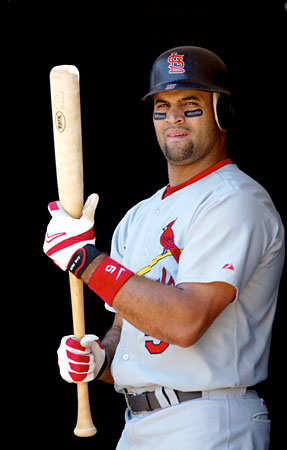
I think it was much deserved, as Pujols put up his usual spectacular numbers, piling up 37 home runs and 116 RBI, all while hitting .357 (the second highest average in the majors). Also, although his team did not make the playoffs, they were in the race and reasonably competitive for most of the season. I think Pujols was the correct pick because he is such an impact player at the heart of the St. Louis lineup. Although St. Louis developed some offensive firepower with the likes of Ankiel and Ludwick, Pujols supporting cast was not as strong and Howard plays in a home ball park notorious for favoring hitters. I am never sure how much bearing the team's end standing has on MVP voting, but I believe as long as the team is competitive for most of the season, the best player from that team should always receive some consideration. In this case, it was the best player in the league, if not the entire majors.

My question for you is, do you agree with selection of Pujols as MVP? You say in your post, "I'm surprised at the lack of support for Hanley Ramirez". While the young Marlins were surprisingly good in many ways, their drop off towards the end of the season contributed to a lot less press coverage for Ramirez. He put up very good numbers, with a high OBP and lots of runs, home runs and stolen bases (though not as many as in years past). What do you think he needs to do different to get more consideration? If Florida had made the playoffs, do you think he would THEN have received a reasonable amount of consideration since the numbers are there?

Also, if you have the chance, I maintain a baseball blog at andrewotoshi.blogspot.com and would greatly appreciate any feedback.

Mets Looking for Strikeouts in Bullpen

Comments:

(Again, please note that access to this blog requires an ESPN Insider subscription.)

Thank you, Buster, for this great post! Mets fans like myself need to get their minds off of yet another late season collapse and instead focus on the upcoming season, and this post (and the entire Mets bullpen) seems like a great place to start. I think you take a very interesting approach to the Mets search for bullpen arms. Bullpen strikeout ratios are not commonly followed statistics, but as you point out that "the eight teams that made the playoffs [were] among the top 10-rnked teams in strikeout ratio in 2008". I fully agree with you that the Mets need some strikeout pitchers to close out games. Billy Wagner was just that. A shutdown closer that relied heavily on his fastball and missed a lot of bats. I like that show his impact on the Mets ratio and was surprised to see his contribution this season (albeit in a limited role) have such an effect. You see the success of teams like the Cubs and Phillies, and a lot of that should be attributed to the back end of their bullpens. Both teams have shutdown relievers for the seventh through ninth innings and because of this, they rarely (never in Philly's case) lost a game they were leading going into the last couple of innings.

The Mets cannot afford to take a risk on a soft reliever like Brandon Lyon or Trevor Hoffman (no matter how impressive his career numbers have been). Even paying Francisco Rodriguez (pictured below) the money he is going to want is a questionable decision as his velocity is dropping and his K/9 ratio is falling. It almost seems like Brian Fuentes will be a better choice. He has become a legitimate closer the past few years and gets a surprisingly high number of strikeouts. He is accustomed to the NL and, in my opinion, if you can save games at Coors Field, you can likely save games anywhere. He is also slightly younger and going to be cheaper than Rodriguez. I also would not mind seeing Kerry Wood pitching late in the game for us, though I do not see how the Mets can invest in such a fragile player when filling their most important off-season need.
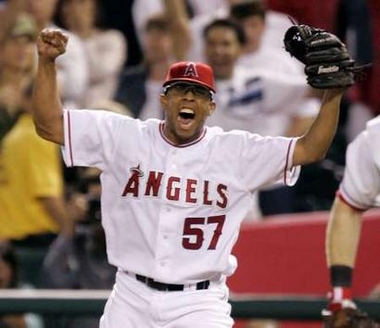
Also, with the trade of Huston Street to Colorado (though I heard he was immediately available again through trade) who are the next top closer's that could be traded? Do you see the Mets making a run at Putz or any other pitchers available through trade? Not sure that the Mets have too many trading pieces, but I also wondered if they would get involved in a trade for Peavy since negotiations with other teams are falling through at the moment.

Also, if you have the chance, I maintain a baseball blog at andrewotoshi.blogspot.com and would greatly appreciate any feedback.

Monday, November 3, 2008

Battling with Boras and 2007-08 Trades in Review

November is a sad time for baseball fans. It marks the end of the baseball season the beginning of a long period in which their appetite for the game can be satisfied through only trade rumors and free agent signings. As I explored the blogosphere, I found and commented on two very interesting posts, one about a baseball agent and another analyzing trades. First, I found a post by Darren Heitner on SportsAgentBlog.com. In his post, Boras May Soon Experience "Total Hell", Heitner discusses a recent arbitration ruling that decided Gary Sheffield had to pay his former agent Scott Boras $550,00 (5% of his $11 million buyout) for his services in negotiating the deal. The second post I commented was on BaseballAnalysts.com. The 2007-08 Winter Trading Season in Review by Marc Hulet. In this post, Hulet covers what he sees as the six biggest trades from last winter and discusses how the course of the 2008 season has changed our perceptions of these trades and the winning and losing teams in them.


First of all, I would like to thankyou Darren for bringing to the audiences attention such an interesting topic of discussion. Interestingly, Scott Boras (pictured below) is one of the best known names in baseball, none of which can be attributed to his actual accomplishments on the field. Instead, he is demonized by baseball fans and front office fans alike for his ability to get huge contract offers for players he represents. I remember when Sheffield initially made this statement regarding Boras and to be honest, I was pretty surprised.

In the past few years, as Boras has become more and more of a negative figure in the baseball world, players he represents have begun dismissing him as they begin contract negotiations with teams. To be honest, I think Boras has unfairly received his bad reputation. The business of sports agency is no different from working in the the front office of a MLB team or playing for one of those teams. A person from any of these three occupational choices will all look to make money first. I just find it ridiculous that teams are able to turn fans against Boras simply because he fails to give in to their contract demands.

I think it has become very clear in the past few years that MLB organizations are making huge profits and if these profits are not in turn invested into top notch players (Boras only represents established stars or ’sure-thing’ draft picks), then the team’s front office and ownership are instead the only one’s profiting. This seems to create unfortunate circumstances in which the teams look to acquire talent at below market price. One must, however, also consider that many of the players that Boras represents, Manny Ramirez, Alex Rodriguez and Garry Sheffield, all are marquee players and likely return the full value of their contracts (even at $20 million or over a year). In just additional ticket sales, merchandising and general fan excitement, Boras claimed (on ESPN’s Jim Rome is Burning) that Manny could return a $25 million dollar a year investment by the Dodgers, not to mention possibly lead them back to the playoffs and perhaps the World Series, as Manny almost managed to do that in only have a season this past year.

In all honesty, I do not quite understand the grounds on which Sheffield claims Boras deserves nothing for his services in the negotiating of the elimination of Sheffield’s $11 million contract. I know Sheffield was planning on leaving Boras and did negotiate his contract with the Yankees himself, but nonetheless, Boras negotiated the elimination of his former contract and simply by the contract he had with Sheffield, he is owed his 5%. I find it a little strange that Sheffield, who made $11 million in the transaction, is going to be so picky about $550,000 when he is currently paid over $13 million.

It seems to me like most of the animosity towards Boras is coming from players and teams that feel Boras is simply reducing their profit margins and therefore standing in the way of them making as large a profit as possible. Perhaps my view is partially biased because I hope to one day work as a sports agent. It just seems to me that players in the league are making so much money (in a large part due to people such as Scott Boras) as are the teams (in a large part due to the players that Boras represents). I guess even though Boras provides a valuable service to players and is the middle man for teams attempting to acquire all the best players, everyone would prefer to pay less for his services and make more for themselves.

I want to know if you see this arbitration decision having any bearing on future events in the world of baseball agency. I think that the panel judged rightly that Boras deserved his share of the settlement and this goes a long way in protecting the rights of agents, even if that agent is despised by a majority of the baseball world. For me, all I can do is give kudos to Boras for reaching the pinnacle of his respected occupation.

Response from Darren Heitner:

Strong comment. I believe that you are correct on many of the points you have made. Even though writers constantly frame Boras in a negative light, he continues to get some of the highest earning clients year in and out. The arbitration decision is good for sports agents. It sends a message to players that they should think twice before trying to stiff their agent after the agent put in hard work to get the player to where he is today. Our labor is not free and must be compensated for accordingly.


(Please note: my comment may not be immediately displayed in the comments section because as a first time poster my comment must first be approved before they will be automatically and immediately displayed)

Thank you Marc for a great post about a topic that really fascinates me. Looking back on the biggest trades of the past off-season can be either a very satisfying experience or a horribly painful one. I thought your analysis of each trade was excellent and I found it difficult to disagree with many of your conclusions about which team was the winner.

I thoroughly enjoyed your thoughts on the Tampa Bay and Minnesota trade, in which Garza and Young were the centerpieces. I agree that it may have been the most significant trade of the past year. I guess what spoke to me most what that for the Rays it was in a way addition by subtraction (with the loss of Delmon Young promoting harmony within the clubhouse). Young was one of the most highly touted young offensive players in the league and although Garza had a great deal of potential, I believed the Twins might be getting the better of Tampa Bay in this trade. This is probably also due to an inability to predict Jason Bartlett's impact on the club.

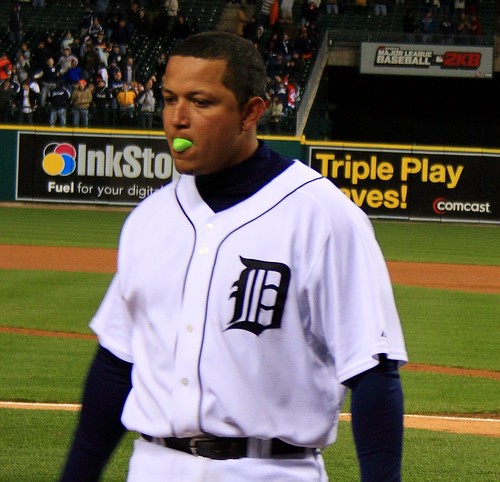
I did wonder about the Detroit and Florida trade however. While I agree that Detroit seemed to be a winner before the trade, I still feel that they got the better of this trade post 2008. It is true that Willis was a disappointment at best but Cabrera (pictured below) ended up having a decently strong season. I just wonder if the Tigers' collapse (after being favorites to head to the World Series preseason) played a large role in assuming this trade was a loss for Detroit. Florida did not seem to get a great deal of production from any pieces of this trade apart from a few late season hits by Maybin. If Willis manages to have a respectable season (10 to 13 wins) and Cabrera performs as we all expect, I do not expect Florida's young haul to have a bigger impact on the team's overall performance in the 2009 season. What are your thoughts on that?

On a more personal note, do you see the Santana trade as a bit of payback to Mets fans after the Kazmir-Zambrano fiasco? Even after two monumental late season failures, I have to believe the Mets have the talent to get there and win it all in 2009 with a few key additions. I maintain a blog about baseball and would love some feedback from a pro.

This is the link: andrewotoshi.blogspot.com

If you could spare any time it could be greatly appreciated.

Monday, October 13, 2008

A Wealth of Information

This week I searched the internet in an attempt to find the best sources for baseball news and analysis on the web. I have picked out 20 sites that stood out in my mind as exceptional sources. Judging the sites according to the Webby and IMSA criteria for evaluating websites and blogs, I will discuss the strengths and weaknesses of each site and how they could be improved. All of these sites will be linked within this post as well as added to my linkroll for future use.

The first site I chose is SportsAgentBlog.com. This is a great site with a lot of unique content. It strays from the traditional baseball news and focuses on the agentry side of baseball, with blog posts by current and aspiring agents. The site is easy to navigate through and is relatively pleasing aesthetically. The second site I found is the Sports Law Blog. Although not terribly attractive, this site is another source for less common news about sports law and business. While not always easy to navigate around, the site has a lot of interesting posts. Baseball Blogs is a site that compiles posts from multiple different blogs around the internet, giving you the day's most popular entries on the home page. The site layout is unattractive and navigation is not always easy, but few places have good posts from so many different sources. Baseball Musings is an interesting site which provides the reader with links to interesting articles about baseball. The author of this site even updates regularly during playoff games with an brief breakdown of each inning. Baseball Analysts is a site with regular posts containing trade, game and team analysis. It has a nice clean layout and is easy to search through. Authors are well informed and they write on interesting subjects. 

The Bats Blog of the New York Times is a site of personal interest because its focus lies on the greatest (in my opinion) baseball city in the world, New York. With a very nice and user friendly interface, this is a great site for all baseball news concerning the Mets or the Yankees. The Baseball America College Blog is an interesting source for information because unlike football and basketball, college baseball does not get that much media attention. At the same time, these are the stars of tomorrow and this site provides insightful reports on up and coming stars at the college level. Len & Bob's Baseball Blog is a fun site hosted by WGN Chicago broadcasters. Although this site focuses on the Cubs, it has lots of entertaining video and is a good site to visit just to
kill some time watching baseball. The site is a bit bare but little navigation is required. Sabernomics.com is my personal favorite of all these sites (Pictured to the right). This is a great site that examines the economic side of baseball. The posts are insightful and articulate and the perspective of the author, an economist and associate professor, are very interesting. Mets Baseball Blog is a site I had to include because it is a great place to visit for up to date news on my beloved New York Mets. This site has links to all things Mets and is a great place for Mets fans looking for news to visit.

Joe Mauer's Baseball Blog grants the reader a look at the life of a baseball star. All-star catcher Joe Mauer gives the reader a look inside his life in this personal blog. The Baseball America Prospects Blog is much like the college baseball blog and provides baseball fans with analysis of minor league players and games, discussing the performances of players likely to be seen in the majors in the next few years. Ask 14 is the official blog of former player Jim Rice. This is another chance for readers to see what a former big league player thinks of current happenings in baseball. The site is well designed and has links to other good baseball (although mainly Red Sox) sites. Knuckle Curve is a baseball blog that provides up to date results and game analysis. This site offers information through a variety of medias, putting videos, sound clips and pictures to good use. Baseball Digest Daily is another blog that provides up to date game summary and analysis. This site's strongest point may be that it has over 20 professional contributors and thus a great deal of posts and information.

ESPN.com has a great selection of baseball blogs. The only problem with site is that it requires a paid subscription to ESPN's Insider service. The blogs found here are excellent though, and in my opinion well worth the money. A wealth of information and easy navigation form a winning combination. MLBlogs (pictured to the left) is the official blog of Major League Baseball. This site has a ton of fan blogs, player blogs and team blogs. It is a great way to see what people think about baseball although it does not always contain intelligent discussion of baseball. ESPN.com's Major League Baseball Photo Wire is a great place to visit for picture of all day's action. A great collection of shots covering the best plays of the day, this is the best site to visit for easy access and high quality major league baseball photos. MLBPlayers.com is the official site of the Major League Baseball Players Association. Here, the audience has access to a number of player sites, as well as stats and player news. USA Today's Rotisserie Corner was the last site I decided to linkroll. This site is a great place for all fantasy baseball managers to go to follow their player's stats throughout the season. The site offers daily, weekly, season and numerous other individual statistics.

Overall, I am very pleased with the results my search has returned. As I plan to further my blogging career, I think I have found numerous sources that will be of great service to me. Hopefully, some of these links might also be helpful to you.

Monday, September 29, 2008

The Amazing-ly Bad Mets and Early Rumblings

September is a grueling month in the world of Major League Baseball. The final month of the regular season, it decides who plays on into October and who goes home early for the offseason. Yesterday saw most teams play their final game of the season and, apart from the American League Central, which will not be decided until Tuesday in a one game play-off between the Minnesota Twins and the Chicago White Sox, the remaining seven playoff teams have been determined. Sadly, the New York Mets have now turned in historically bad performances two seasons in a row to force themselves out of the playoffs when leading the division with seventeen games to go. For the next five months, my interest will be in how the Mets and the rest of the MLB plan to solve any problems the teams have via the free-agent market, via trade, or even through changes in the front office. For some early rumors (the big moves and real discussions do not usually begin until the winter meetings in December) I decided to surf the blogosphere. To my delight, I found two very interesting posts in the very same blog, ESPN.com's Buster Olney Blog. This was a great find because Buster Olney is a senior writer at ESPN The Magazine and has been covering baseball since 1989. Before ESPN The Magazine, Olney worked at The New York Times for six years covering baseball, the Mets and Yankees in particular. I was initially drawn to this blog because his most recent post, Mets' big hope for 2009... fix Wright was concerning the Mets 2008 collapse and speculated on things they could look to change in 2009. The second post that attracted my attention was Ten thoughts about the free-agent market, a post in which Olney presents ten interesting thoughts about what to look for this offseason. In addition to publishing my comments directly on Olney's blog, I have also posted these comments below.

(Please Note: Only subscribers to ESPN.com's Insider will be able to view the blogs and comments in full. I apologize for any inconvienence caused)


Thank you for a great post that highlights something I also saw as a major problem for the Mets this season. While most of the discussion of the Mets' failure this season will focus on the torrid time had by the bullpen after Billy Wagner went down with an injury, I think the offense kept too many games close enough for the bullpen to be put under pressure and blow the game. When you look at their lineup, the Mets look like a time that should rarely struggle to score runs. Yet, throughout the course of the season the fact that the Mets never overcame a four-run deficit shows that the offense might be prone to just give up or disappear some games. I agree that David Wright's struggles with runners in scoring position were a huge part of this. In the last week of the season alone, it seemed like every time Wright had the chance to make an impact he was a non-factor at the plate. This was hugely disappointing after he put up numbers through the season that could have gained him a few votes in the MVP race.
I like your idea about the sports psychologist. Look at Wright when he is happy and relaxed: he's all smiles, flashy handshakes with Jose Reyes (pictured to the left), huge numbers and Met wins. What concerns me most is that next year, with two consecutive September collapses on their minds, will Wright and the Mets offense disappear entirely? Also, do you see the Mets entering the Sabathia race? Do you think they will make a strong attempt to sign K-Rod? Do you think Minaya deserves his extension?


Thank you Buster this is a very interesting post for those of us without teams playing ball in October. As a Mets fan, the only things I have to look forward to is a new stadium and potential free-agent signings. As I maintain a blog about contracts, trades and statistics, your post served me very well. I think your first thought is very interesting because it shows how baseball's economy works in relation to the nation's. In recent years
contracts have skyrocketed in value and an economic recession could play a large part in reducing the number of overpaid players. With Sabathia (pictured to the right), do you see him making whatever team he decides to play for favorites to reach the World Series? With seemingly only contenders vying for his services and seeing what he has done for Milwaukee in the past nine days let alone the past few months, he seems like he could be a real difference maker in '09. Since "the market for starting pitching, in general, is going to be better than expected" do you see a decline in $10 million contracts being given to mediocre starters? Something else I was hoping to find in your post was a discussion of young players that may be ready to make some sort of an impact, the Soto's and the Longoria's of next year and also, who you feel the biggest impact bat will be this offseason. As a resident of Los Angeles, I am curious as to what the future of Manny Ramirez will be.

Monday, September 22, 2008

Dodger Success: Still Just Manny Being Manny?

Now is a wonderful time for a baseball fan to be living in Los Angeles. Not only have the Los Angeles Angels of Anaheim clinched a playoff spot by winning their division, they also have the best record in the the entire Major Leagues at (96-59). At the same time, the Los Angeles Dodgers have made a recent surge and find themselves two and a half games ahead of the Arizona Diamondbacks in first place in the National League West. While the Angels have consistently been one of the best teams in the Majors, the Dodgers have had trouble finding consistency and have not won a World Series title since 1988. The Dodgers are a large market team that has, in the recent years, failed to progress past even the first round of the playoffs. To say they are not talented would be wrong, as they built their team around a young nucleus of skilled players in Russel Martin, James Loney, Andre Ethier, Matt Kemp, Chad Billingsly, Clayton Kershaw and Jonathan Broxton. They even had veteran contributions from Derek Lowe, Nomar Garciapara, Jeff Kent and Greg Maddux, though none of this was enough. It was only after they acquired Manny Ramirez from the Boston Red Sox that they were able to perform consistently at a high level.

For 15 years, Manny has thrilled management and fans alike as he established himself as one of the best hitters of all time. A perfect blend of power and precision, Manny is a career .314 hitter with 526 homeruns and 1721 RBIs. In 2000, his numbers were already good enough to fetch him a $168 million 8-year contract on the free-agent market from the Boston Red Sox, thanks also to super-agent Scott Boras. Although he continued to perform exceptionally for the first 7 years of his contract, Manny started making headlines for all the wrong reasons. The conflict began with little things like failing to run out a grounder and progressed to inexplicable plays like forgetting how many outs there are or making an acrobatic play to catch a ball that was not intended for him and should not have been caught by him. Then came the offseason trade demands. It seemed like after every season Manny was demanding a trade. There was always interest, but his contract and the package of players it would take to pull off a trade were always too high. It was more than this, however, as Manny's performances on the field always caused the Red Sox to hesitate when seeking to meet his trade demands. As frustrating as Manny was and as distracting as he became within the organization, his offensive numbers were always too good for the Red Sox to let go of, at least until this past summer. Let us not forget that Manny led the Red Sox to world series titles in 2004 and 2007.

This year, however, after a tormenting first half of the season in which Manny seemed to choose when he played, removing himself from the game if he felt the pitcher threw too hard or he just did not like the matchup, the Red Sox finally tired of his antics and his incessant trade demands and shipped him off to the Dodgers in a three-team trade that also included the Pittsburgh Pirates. Perhaps the most surprising feature of this trade was that the Dodgers were only forced to give up two minor league pitchers and pay only a $1 million option on Ramirez's contract that was enacted once he was traded. This seemed like a steal on paper even if they only retained Ramirez's services for the remainder of the season. Amidst all the negative media, Ramirez had been able to put together a good half season, batting .299 with 20 home runs and 68 RBIs and his production was expected to continue in Los Angeles. Though it seemed like the Dodgers were practically stealing a premier power hitter from the Red Sox, Donald Todrin puts it a bit differently in his "Lets-Talk-Business" blog, saying the Red Sox "understand that to be a world class champion, "team" is more important than individual performance".

These same questions regarding Ramirez's commitment to the team and to winning lingered, however, as the public disintegration of his relationship with the Red Sox was watched closely by GMs across the nation. Most people felt that Manny tended to be concerned only with himself and his next massive contract. Those questions were dispelled almost immediately as he began almost single handedly carrying the Dodgers to the top of their division. In his first 44 games with the Dodgers, Ramirez is hitting .400 (a magic number in baseball that may never be attained as a full-season batting average again) with 44 RBIs. His performances have been so good that he has been mentioned in discussions for the National League Most Valuable Player award. Manny, however, feels he doesn't deserve to be NL MVP, saying "I'd like to win it. But i have to be realistic. Someone who was only here for two months doesn't deserve it. It should go to someone who played the six months of the season". These are surprising words coming from a supposedly egocentric and undeniably selfish character. While it remains unlikely that he will win the award, the fact that he even receives consideration for 2 months work out of a 6 month season says a lot about his ability to perform on the field, and helps explain why he is always given a chance to play, no matter what conflict he has just stirred up.

What is even more amazing is that his behavior has perhaps been even better than his on-field performances. Teammates like Dodgers catcher Russel Martin say that Manny "has brought a new life to the team" and that "they feel like they are better" as a team. Before getting Manny, the Dodgers were just at .500 at (54-54) but since then have gone (25-19). This improvement along with a slumping Arizona team has seen them land comfortably in the lead of their division. Jerry Crasnick writes that "by assuming the role of leading man in the clubhouse, he has made the most startling Hollywood transformation since
Bill Murray went from 'Caddyshack' to 'Lost in Translation'". Who would ever have thought after his actions in Boston that Manny would become a leading figure of a harmonious clubhouse? This good behavior has not cleared him all charges against him, however, as a few questions still remain concerning Ramirez's future beyond this season.

The Dodgers love what they have gotten from Ramirez thus far, but have concerns about the type of contract he will be asking for in the offseason, especially after his monster second half of the season. Concerns are that Manny will lose his focus on baseball once he receives a contract that pleases him (probably 3 to 4 years at over $20 million a year) and may return to being the disruptive clubhouse force we saw earlier this year. A common notion in the world of baseball is that players typically perform better in walk years (the year right before their current contract runs out and they will become free agents) in hopes of securing a large new contract. After securing these contracts, however, some players fail to be as motivated and their on-field performances suffer as a consequence. At 36 years of age, Manny is likely past his prime and although he can still be productive, it is likely that his production levels will drop in the next few years. Combine that with the defensive liability that he is, BleacherReport.com says that he "is not in the best physical shape of his career" and that his performance in left-field is "sluggish" and "irritating". It seems like Manny will have to return to the American League where he can be a DH, stay out of the field and extend his career as long as possible.

It remains to be seen what kind of contract offers Manny will be receiving, but what is clear is that with all the money in baseball, someone will most likely be willing to part with $25 million per year over at least 2 years just for the chance that he decides to stay focused and continues to produce on the field. What does this say about the condition of the game of baseball? A star player can bully a team into trading him and then gets a huge reward for performing only once he gets exactly what he wants and has the most incentive. Another concern is that Manny will set a precedent for players that are not happy on their team and we will see a number of star players force their way into trades. If there is no risk of a pay cut at the end of that ordeal, what is stopping the players from demanding what they want and refusing to play if they do not get it? Let us just hope that teams do not forget Manny's troubled past when making their contract offers this fall.
 
Creative Commons License
This work is licensed under a Creative Commons Attribution-Noncommercial-No Derivative Works 3.0 Unported License.