Showing posts with label New York Mets. Show all posts

Tuesday, November 18, 2008

What Makes an MVP? and K Relief for the Mets

Just last Friday, the official free agent season started as team's lost their sole rights to negotiate contracts with impending free agents. All teams can now offer an available player a contract. Things are still slow, however, and with only one signing during these first few days (Jeremy Affeldt to the San Francisco Giants for anyone interested) there were some more other important stories circulating throughout the blogosphere. Last week began the announcement period for in season awards such as the Rookie of the Year, Cy Young (for pitchers), the Manager of the Year and the league MVPs (for outfield and offensive players). Thus, the first post I decided to comment on was from BaseballMusings.com. Written by David Pinto, Pujols Wins MVP discusses the slugger's victory in what looked to be a close race with Ryan Howard. The second post I commented on was from Buster Olney's ESPN.com Baseball Blog. This post, entitled Mets Looking for Strikeouts in Bullpen, looks at the team's needs from an interesting perspective and outlines a few scenarios and the pros and cons of each scenario.

Pujols Wins MVP

First off, I would like to thank you for an informative post. The debate about who would win the NL MVP award was heating up towards the end of the season and, to be honest, it really seemed like Ryan Howard was going to win it because of his huge late-season numbers and the fact that his team won the division (NL East) and was going to the playoffs for a second straight year. I know that Howard's numbers were not all pretty, especially his .251 batting average and his 199 strikeouts. But, nonetheless, he still led the majors with 48 home runs and 146 RBI. Also, as I mentioned before, it almost seemed like Howard single handedly carried his team through much of August and September, coming up with huge hits almost every game. The combination of his power numbers, his September surge and his team making the playoffs, I feared MVP voters might give too much significance to any particular statistical category or the fact that his team had a chance to play on into October. It seems my fears were unwarranted, however, as Albert Pujols (pictured to the left) won the NL MVP award.
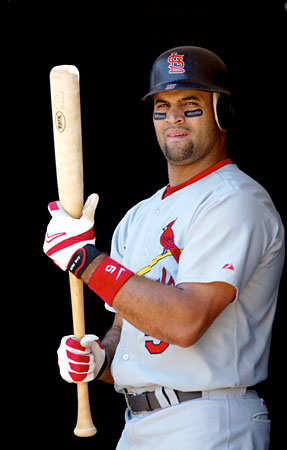
I think it was much deserved, as Pujols put up his usual spectacular numbers, piling up 37 home runs and 116 RBI, all while hitting .357 (the second highest average in the majors). Also, although his team did not make the playoffs, they were in the race and reasonably competitive for most of the season. I think Pujols was the correct pick because he is such an impact player at the heart of the St. Louis lineup. Although St. Louis developed some offensive firepower with the likes of Ankiel and Ludwick, Pujols supporting cast was not as strong and Howard plays in a home ball park notorious for favoring hitters. I am never sure how much bearing the team's end standing has on MVP voting, but I believe as long as the team is competitive for most of the season, the best player from that team should always receive some consideration. In this case, it was the best player in the league, if not the entire majors.

My question for you is, do you agree with selection of Pujols as MVP? You say in your post, "I'm surprised at the lack of support for Hanley Ramirez". While the young Marlins were surprisingly good in many ways, their drop off towards the end of the season contributed to a lot less press coverage for Ramirez. He put up very good numbers, with a high OBP and lots of runs, home runs and stolen bases (though not as many as in years past). What do you think he needs to do different to get more consideration? If Florida had made the playoffs, do you think he would THEN have received a reasonable amount of consideration since the numbers are there?

Also, if you have the chance, I maintain a baseball blog at andrewotoshi.blogspot.com and would greatly appreciate any feedback.

Mets Looking for Strikeouts in Bullpen

Comments:

(Again, please note that access to this blog requires an ESPN Insider subscription.)

Thank you, Buster, for this great post! Mets fans like myself need to get their minds off of yet another late season collapse and instead focus on the upcoming season, and this post (and the entire Mets bullpen) seems like a great place to start. I think you take a very interesting approach to the Mets search for bullpen arms. Bullpen strikeout ratios are not commonly followed statistics, but as you point out that "the eight teams that made the playoffs [were] among the top 10-rnked teams in strikeout ratio in 2008". I fully agree with you that the Mets need some strikeout pitchers to close out games. Billy Wagner was just that. A shutdown closer that relied heavily on his fastball and missed a lot of bats. I like that show his impact on the Mets ratio and was surprised to see his contribution this season (albeit in a limited role) have such an effect. You see the success of teams like the Cubs and Phillies, and a lot of that should be attributed to the back end of their bullpens. Both teams have shutdown relievers for the seventh through ninth innings and because of this, they rarely (never in Philly's case) lost a game they were leading going into the last couple of innings.

The Mets cannot afford to take a risk on a soft reliever like Brandon Lyon or Trevor Hoffman (no matter how impressive his career numbers have been). Even paying Francisco Rodriguez (pictured below) the money he is going to want is a questionable decision as his velocity is dropping and his K/9 ratio is falling. It almost seems like Brian Fuentes will be a better choice. He has become a legitimate closer the past few years and gets a surprisingly high number of strikeouts. He is accustomed to the NL and, in my opinion, if you can save games at Coors Field, you can likely save games anywhere. He is also slightly younger and going to be cheaper than Rodriguez. I also would not mind seeing Kerry Wood pitching late in the game for us, though I do not see how the Mets can invest in such a fragile player when filling their most important off-season need.
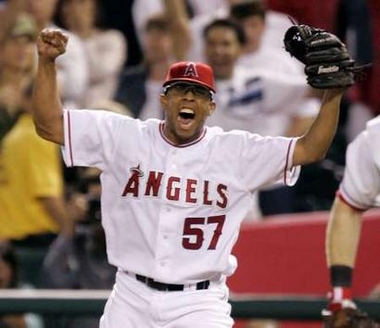
Also, with the trade of Huston Street to Colorado (though I heard he was immediately available again through trade) who are the next top closer's that could be traded? Do you see the Mets making a run at Putz or any other pitchers available through trade? Not sure that the Mets have too many trading pieces, but I also wondered if they would get involved in a trade for Peavy since negotiations with other teams are falling through at the moment.

Also, if you have the chance, I maintain a baseball blog at andrewotoshi.blogspot.com and would greatly appreciate any feedback.

Tuesday, October 28, 2008

Money Ball: Are Teams Getting Bang for Their Buck?

This week I decided to focus my post on an attempt to find some connection between a team's salary and wins this season, taking into account different age factors. What I hope to discover is the foundation upon which a winning team is built. To start, I decided to narrow my focus to just a few teams. In this instance, it seemed fitting to choose both the Philadelphia Phillies and the Tampa Bay Rays, seeing as these are the two teams in the World Series and the only teams left playing meaningful games this season. I also chose both New York teams, the Mets and the Yankees, because both of these teams defied expectations in failing to even make it to the playoffs.

To begin my analysis, I searched for a listing of team payrolls (the total salaries of players on the major league roster on open day) and found it on the CBS Sports website. A close examination of this table provides interesting results as we find the two World Series teams ranking 29 out of 30 (Tampa Bay) and 13 out of 30 (Philadelphia) in terms of highest opening day payroll. The Rays have a team salary of $43,820,598, higher only than Florida, whose $21 million team salary is less than half that of any other team in the league. Philadelphia has a team salary of $98,269,881, which ranked third lowest amongst playoff teams (Milwaukee and Tampa Bay were lower). The two New York teams on the other hand, ranking 1 out of 30 (Yankees) with a $209,081,579 team salary and 3 out of 30 (Mets) with a $138,293,378 team salary, both failed to bring playoff baseball to New York in the final year of both Yankee Stadium and Shea Stadium.

A team's payroll is indicative of a number of things. First, large payrolls likely indicate famous players either right in their prime or towards the tail end of it. This is because players tend to receive their largest contracts between the ages of 25 and 30 (typically where one is expected to enjoy his most productive seasons). Thus, smaller payrolls can be indicative of either less star power or simply younger players that will not reach free-agency for a few years and are signed to team-friendly contracts. I believe both of these principles are applicable to the teams in question, with the Mets and Yankees representing the failures of large payrolls and the Rays and Phils showing how success does not have to be so expensive.

A better way to get an idea of how efficiently a team goes about trying to win is to take the team's payroll and divide it by that team's wins from the regular season. In Tampa Bay's case, with their 97 wins (third best in the majors) and small payroll, each win this season cost them only around $451,758. The Phillies, with 92 wins, paid $1,068,150 per win. The Yankees and the Mets, who both finished the season with 89 wins, paid $2,349,231 and $1,553,858 respectively per win. There must be a good explanation for the apparent discrepancy between the successes and failures of this year's Major League Baseball season.

Another factor that may prove relevant in this situation is the average age of the team. ESPN.com provides a table ordered by team's average age. Here, we see Tampa Bay rank 5 out of 30 in terms of youngest average age at just 27.2 years. The Yankees are next with an age of 28.9 and a rank of 21 out of 30. The Mets and Phillies round out the bottom of the table, finishing 28 out of 30 and 30 out of 30, respectively at 30.3 and 31.3 years of age. This does not appear to tell us much, however, as it is not clear that any conclusions can be reached on the basis of this data alone.

Although the average age may not have provided that much insight into what seems to make a team successful, the age of a team's most significant players can provide such insight. Take a look at the Rays and the Phillies. At their core, both teams are comprised of homegrown talent and cheaply (relatively speaking) signed veterans and role players. The Rays are
the perfect example of a contender built from the ground up. The Rays were an expansion team created ten years ago and their focus has always been on drafting high-risk, high-return players in an attempt to build a winner. This policy has finally paid off as the likes of Carl Crawford, BJ Upton, Evan Longoria and the emerging David Price (pictured to the left) all have played huge parts in Tampa's unlikely run to the World Series. In some ways, Tampa Bay's lack of success in the first years of the organization might repay itself as their poor record constantly gave them high draft picks with which to develop All-Star caliber talents. Their poor record also allowed them to take risks signing unproven or aging players to cheap, incentive laden contracts. This is what they did with Carlos Pena, who has been exceptional at the heart of this Rays lineup throughout the past few seasons.

Philadelphia follows in a similar mold. Although the Phillies' payroll is substantially higher than Tampa Bay's, the centerpieces of the team are younger players signed to cheaper contracts. In Ryan Howard, Chase Utley, Jimmy Rollins and Cole Hamels, the Phillies have four homegrown stars, of whom only Howard is making at least $10,000,000 (not such a substantial number in the world of baseball). Although the Phillies have signed a few veterans to large, overpriced contracts, the majority of their production comes from cheap, rising talents, only just entering their prime.

The Yankees provide a stark contrast to the Rays and Phillies. Although their average age was not particularly high, the significant players on the Yankees roster are all well closer to 30 than they are to 20. The Yankees have a huge payroll because they like are always willing to overpay established veterans for too many years. The current Yankees can be seen as a team suffering from bad long term contracts. Although normally the team to compete with, this year it seems the Yankees age finally caught up with them. A majority of their players have had wonderful, perhaps even Hall of Fame worthy careers and yet, if they are all at the back end of their baseball lives, the team just is not going to win. There is a large talent gap between the Yankees' aging stars of yesteryear and growing stars of tomorrow, and it really showed this season.

The Mets, like the Yankees, have such a high payroll and failed to make it to the playoffs because they opted for the priciest players that may have already experienced their best years. An ailing Pedro Martinez and a cumbersome Luis Castillo are just two examples of overpaid, underperforming Mets. Carlos Beltran, the Mets highest paid player has never lived up to his huge contract. Carlos Delgado seemingly chose not to play half of last season and Billy Wagner was out for large parts of the season due to injury. The natural decline due to aging played a factor in the substandard performance of some of these players and the Mets will be glad to see Wagner and Martinez's contracts end.

In the end, it seems the New York teams' decision to go with primarily established stars over internally developed players hurt them. Rising contract prices and a number of bad signings and trades are forcing both these teams to reconsider their methods. It is causing them to adopt the methods of the Rays and Phillies. Intense scouting and high-risk, high-reward drafting policies allow teams to pick up impact players while they are young and cheap and develop them as they please. Instead of constantly competing for free-agents that may or more not perform, but will get paid big bucks regardless, teams that build a young core of talented players stand the best chance of consistently being a competitive and winning team. One important point to make note of here, and one which I hope to discuss in the following weeks, is that the financial restrictions placed on teams like the Rays (due to lack of stadium attendance and fan activity) may prevent them from resigning essential players once their current contracts are up. Instead, they could be forced to trade off all of their stars before they hit free-agency in an attempt to get some talent in return, just as their in-state competitors, the Florida Marlins were forced to do just a year after winning the World Series.

Monday, September 29, 2008

The Amazing-ly Bad Mets and Early Rumblings

September is a grueling month in the world of Major League Baseball. The final month of the regular season, it decides who plays on into October and who goes home early for the offseason. Yesterday saw most teams play their final game of the season and, apart from the American League Central, which will not be decided until Tuesday in a one game play-off between the Minnesota Twins and the Chicago White Sox, the remaining seven playoff teams have been determined. Sadly, the New York Mets have now turned in historically bad performances two seasons in a row to force themselves out of the playoffs when leading the division with seventeen games to go. For the next five months, my interest will be in how the Mets and the rest of the MLB plan to solve any problems the teams have via the free-agent market, via trade, or even through changes in the front office. For some early rumors (the big moves and real discussions do not usually begin until the winter meetings in December) I decided to surf the blogosphere. To my delight, I found two very interesting posts in the very same blog, ESPN.com's Buster Olney Blog. This was a great find because Buster Olney is a senior writer at ESPN The Magazine and has been covering baseball since 1989. Before ESPN The Magazine, Olney worked at The New York Times for six years covering baseball, the Mets and Yankees in particular. I was initially drawn to this blog because his most recent post, Mets' big hope for 2009... fix Wright was concerning the Mets 2008 collapse and speculated on things they could look to change in 2009. The second post that attracted my attention was Ten thoughts about the free-agent market, a post in which Olney presents ten interesting thoughts about what to look for this offseason. In addition to publishing my comments directly on Olney's blog, I have also posted these comments below.

(Please Note: Only subscribers to ESPN.com's Insider will be able to view the blogs and comments in full. I apologize for any inconvienence caused)


Thank you for a great post that highlights something I also saw as a major problem for the Mets this season. While most of the discussion of the Mets' failure this season will focus on the torrid time had by the bullpen after Billy Wagner went down with an injury, I think the offense kept too many games close enough for the bullpen to be put under pressure and blow the game. When you look at their lineup, the Mets look like a time that should rarely struggle to score runs. Yet, throughout the course of the season the fact that the Mets never overcame a four-run deficit shows that the offense might be prone to just give up or disappear some games. I agree that David Wright's struggles with runners in scoring position were a huge part of this. In the last week of the season alone, it seemed like every time Wright had the chance to make an impact he was a non-factor at the plate. This was hugely disappointing after he put up numbers through the season that could have gained him a few votes in the MVP race.
I like your idea about the sports psychologist. Look at Wright when he is happy and relaxed: he's all smiles, flashy handshakes with Jose Reyes (pictured to the left), huge numbers and Met wins. What concerns me most is that next year, with two consecutive September collapses on their minds, will Wright and the Mets offense disappear entirely? Also, do you see the Mets entering the Sabathia race? Do you think they will make a strong attempt to sign K-Rod? Do you think Minaya deserves his extension?


Thank you Buster this is a very interesting post for those of us without teams playing ball in October. As a Mets fan, the only things I have to look forward to is a new stadium and potential free-agent signings. As I maintain a blog about contracts, trades and statistics, your post served me very well. I think your first thought is very interesting because it shows how baseball's economy works in relation to the nation's. In recent years
contracts have skyrocketed in value and an economic recession could play a large part in reducing the number of overpaid players. With Sabathia (pictured to the right), do you see him making whatever team he decides to play for favorites to reach the World Series? With seemingly only contenders vying for his services and seeing what he has done for Milwaukee in the past nine days let alone the past few months, he seems like he could be a real difference maker in '09. Since "the market for starting pitching, in general, is going to be better than expected" do you see a decline in $10 million contracts being given to mediocre starters? Something else I was hoping to find in your post was a discussion of young players that may be ready to make some sort of an impact, the Soto's and the Longoria's of next year and also, who you feel the biggest impact bat will be this offseason. As a resident of Los Angeles, I am curious as to what the future of Manny Ramirez will be.

 
Creative Commons License
This work is licensed under a Creative Commons Attribution-Noncommercial-No Derivative Works 3.0 Unported License.